Home About Research AfriScore Publications Speaking Projects
AfriScore JuriQuants JQ.AI

Building Africa’s Credit Intelligence Infrastructure.
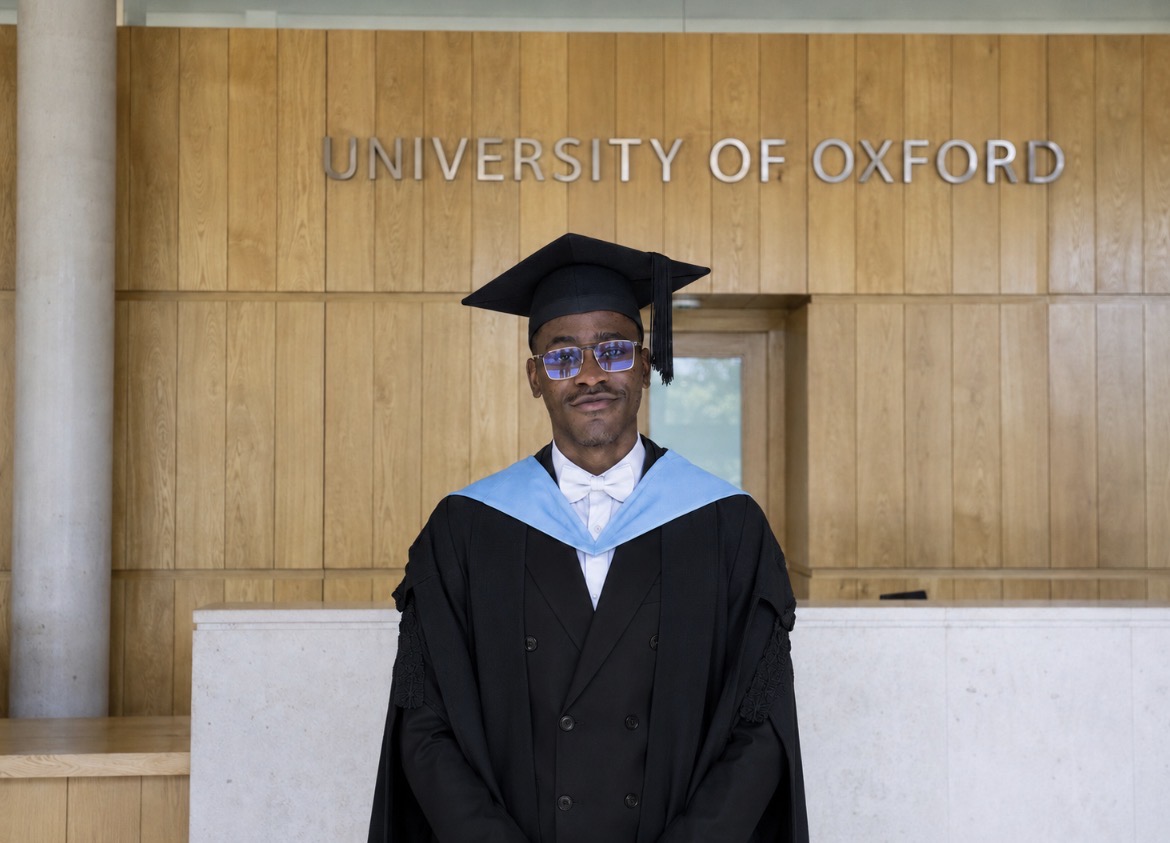
Charles Mfouapon

MSc Law & Finance '26, Oxford

CFA · CKA · FMVA · FRM

The Architecture of African Financial Infrastructure

Pre‑order now. Full manuscript delivered July 24, 2026.

00Days
:
00Hours
:
00Minutes
:
00Seconds
Pre‑order on Amazon

Mission & Background

Charles Mfouapon

Charles Mfouapon

Founder of AfriScore. I build credit intelligence, financial infrastructure, and quantitative risk models for emerging African markets.

Why Africa? Because 300 million adults are credit-invisible. 68% of the population uses mobile money, yet fewer than 34% have a bank account. The opportunity to build financial infrastructure from first principles—using alternative data, machine learning, and mobile rails—is the defining challenge of this generation.

I hold a Master of Science in Law and Finance from the University of Oxford, complemented by training in financial engineering at WorldQuant University distance learning and quantitative research methodologies.

My research spans capital markets regulation, systemic finance, AI applications in financial infrastructure, fintech and regtech systems, and quantitative approaches to investment and risk analysis in emerging markets.

English — NativeFrench — Native
Download CV PDF · Updated July 2026

Education

Sep 2025 – Aug 2026

University of Oxford

Master of Science in Law and Finance · Keble College

Oct 2025 – Oct 2027

WorldQuant University

Master of Science in Financial Engineering · Distance Learning

Sep 2022 – Aug 2025

University of London

Online Bachelor of Science in Mathematics and Economics · First Class Honours

Oct 2022 – Sep 2025

Catholic University of Central Africa

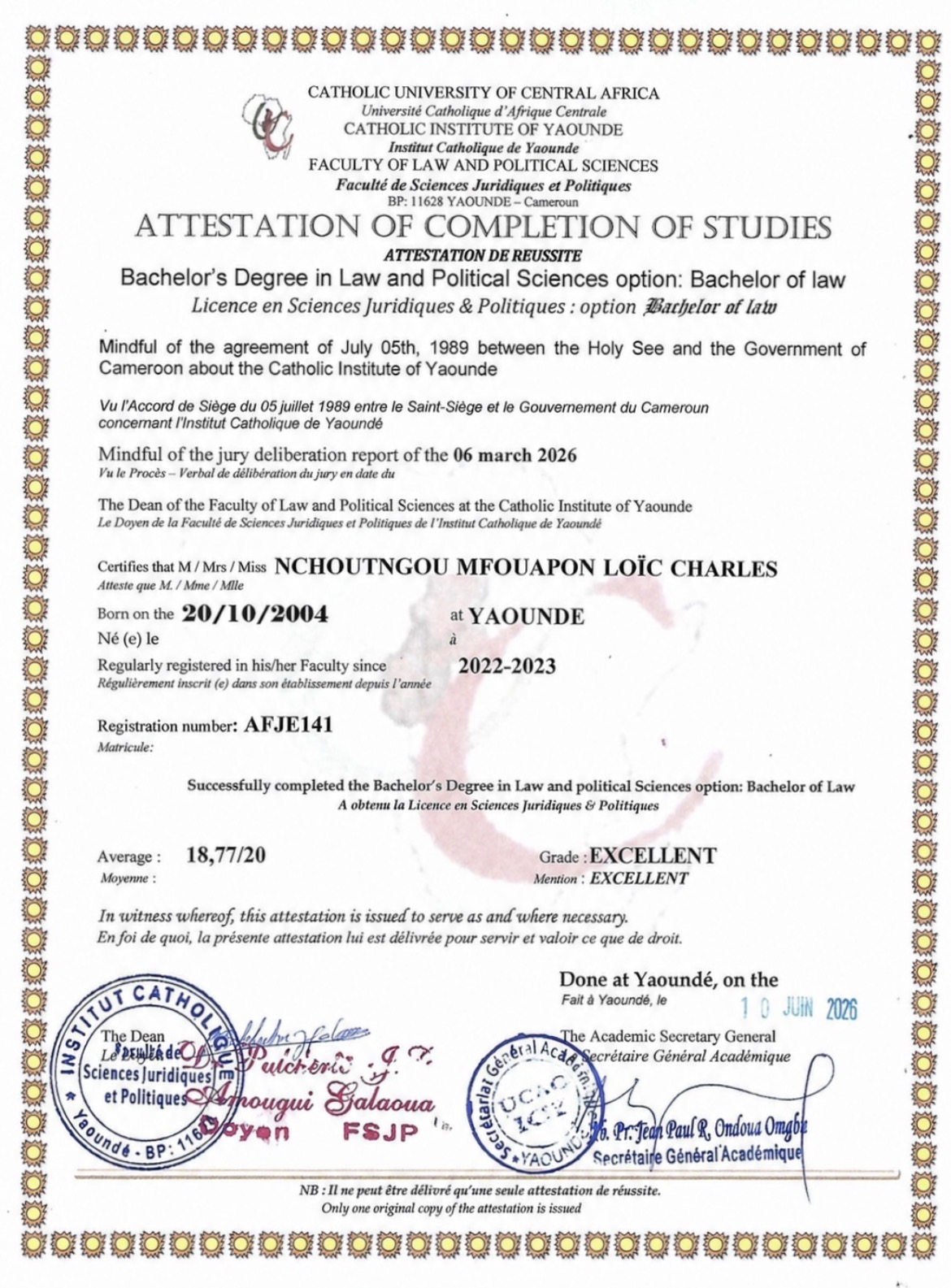
Bachelor of Laws · First Class

Experience

Jan 2024 – Present

Founder · AfriScore

Credit intelligence and financial inclusion across African markets.

Jan 2026 – Present

Investment Committee Member · Oxford Seed Fund

Evaluating early-stage ventures across fintech, AI, and financial infrastructure.

Oct 2025 – May 2026

Quantitative Research Fellow · CUHK Centre for Financial Engineering

Quantitative risk modeling, portfolio optimization, financial machine learning.

Jun 2025 – Aug 2025

Legal Assistant - Regulation & Legal Affairs · Representation of CEMAC in Cameroon

Led the team that drafted the revised agreement between OHADA and the CEMAC Commission.

May 2023 – Feb 2025

Economic Policy Analyst · Nkafu Policy Institute

Researched and analyzed economic and monetary policies around the OHADA and CEMAC sub-region.

Certifications

Google Professional Machine Learning Engineer

Google · Jun 2026

Certified Kubernetes Administrator

Linux Foundation · Jun 2026

CFA Levels I & II Passed

CFA Institute · Jul 2026

FRM Part I Passed

Global Association of Risk Professionals · Feb 2026

Solicitor of the Senior Courts of England and Wales

Solicitors Regulation Authority · Jan 2026

Financial Modeling & Valuation Analyst

Corporate Finance Institute · Apr 2026

Pillar Topics

Comprehensive research hubs that define my work. Each pillar is a living document—updated with new papers, data, and frameworks as the field evolves.

Credit Intelligence in Africa
Alternative data scoring, mobile money credit signals, psychometric assessment, and the $100B credit gap. Home of the Mfouapon Credit Intelligence Framework.
Core6 papers
CEMAC & OHADA Financial Infrastructure
Regulatory frameworks, algorithmic trading voids, systemic risk modeling, and the legal architecture of African capital markets.
Regulation4 papers
Explainable AI & Financial Ethics
Algorithmic determinism, fiduciary duty for quants, the liability of autonomous financial agents, and the ethics of high-frequency thought.
AI Ethics5 papers

African Credit Intelligence Infrastructure

An AI-powered credit scoring platform built for mobile-first, data-scarce, and regulatorily fragmented markets. We turn mobile money transaction data into accurate, explainable credit risk assessments.

The Problem

300 million African adults are credit-invisible. Traditional credit bureau coverage remains below 5% in most sub-Saharan countries. Mobile money penetration is 68%. The data exists — it's just not being used for credit assessment. AfriScore changes that.

Technical Approach

Ensemble machine learning combining XGBoost, Random Forest, and logistic regression. 200+ features extracted from mobile money transaction histories, utility payments, and social graph data.

AUC 0.78

Out-of-sample predictive accuracy

Explainability

SHAP values for every credit decision. We don't just return a score — we explain why. This ensures fairness, regulatory compliance, and trust with borrowers and lenders.

100%

Of scores include explanation

Validation & Impact

Validated on 50,000 mobile money users across Kenya, Uganda, and Nigeria. 40% of previously credit-invisible individuals scored above viable lending thresholds.

40%

Newly credit-qualified population

Architecture Overview

[Mobile Money APIs][Feature Engine][Ensemble Model][Credit Score + SHAP Explanation]
Read the Research Request a Demo

Research, Papers & Articles

Published research, working papers, and essays on financial regulation, systemic risk, and capital markets in emerging economies.

Latest from Substack, Medium & LinkedIn Auto-updated

Loading latest posts...

All Publications

Click any publication to read in full.

Showing all 20

Talks & Lectures

I speak on financial infrastructure, quantitative methods, African market development, and the intersection of law and technology.

Modeling Systemic Risk in Low-Liquidity Environments
Quantitative approaches to risk assessment in frontier markets with limited data availability.
CUHK2026
The Architecture of African Financial Infrastructure
Designing credit systems, payment rails, and regulatory frameworks for fragmented African markets.
Oxford2026
Alternative Data in Credit Assessment: An African Framework
Mobile money, social graph, and psychometric data for credit scoring.
SSRN2026

Book Me to Speak

Available for keynotes, panels, and guest lectures. In-person or virtual.

Get in Touch

Financial Infrastructure

Open-source systems built for correctness under adversarial conditions. Property-tested, fuzzed, benchmarked.

Visual Journey

Photos, videos, and milestones from my academic and professional path.

Featured Videos

Photo Gallery

The Architecture of African Financial Infrastructure

The Architecture of African Financial Infrastructure

Pre‑order now. Full manuscript delivered July 24, 2026.

00Days
:
00Hours
:
00Minutes
:
00Seconds
Pre‑order on Amazon

About the Book

African financial infrastructure is the world's most overlooked financial system. With 300 million credit-invisible adults, 68% mobile money penetration, and a $100B+ credit gap, the continent is building financial rails from first principles — not from Western templates.

This book examines how African markets are redesigning credit, payments, and regulatory frameworks for mobile-first populations, data-scarce environments, and fragmented jurisdictions. It draws lessons for fintech, regtech, and financial infrastructure globally.

From the rise of mobile money as a settlement layer to the development of alternative-data credit scoring models, African financial infrastructure offers a blueprint for financial inclusion that the rest of the world is only beginning to discover.

What I'm Focused On

A snapshot of my current priorities, updated every few months. Inspired by Derek Sivers' Now page movement.

Last updated: July 2026

Building

AfriScore — Refining the alternative-data credit scoring engine. Running validation trials with a microfinance partner in Kenya. The ensemble model is demonstrating strong predictive accuracy on out-of-sample data.

JQ.AI — Open-source legal AI platform for African jurisdictions. Expanding coverage to include more OHADA and ECOWAS legal instruments and improving the 4-stage citation verification system.

Studying

MSc Law & Finance — Oxford — Writing my dissertation on algorithmic trading regulation and systemic risk in OHADA jurisdictions.

MSc Financial Engineering — WorldQuant University — Advanced stochastic calculus, derivatives pricing, and portfolio optimization.

Reading

The Order of Time — Carlo Rovelli
Debt: The First 5,000 Years — David Graeber (re-read)
The Technological Society — Jacques Ellul
Principles of Corporate Finance — Brealey, Myers, Allen
Reinforcement Learning: An Introduction — Sutton & Barto

What I'm Reading

Books that have shaped my thinking on finance, law, systems, and philosophy. Affiliate links support my work at no cost to you.

What I Back

Investor at Oxford Seed Fund. I evaluate early-stage ventures across fintech, AI, and financial infrastructure — with a particular focus on emerging markets and Africa.

Thesis

The most undervalued opportunity in technology today is financial infrastructure for emerging markets — specifically Africa. 300 million credit-invisible adults. 68% mobile money penetration against 34% bank account penetration. A $100B+ credit gap. The rails are being built now, and the companies building them will define the next two decades of African economic development.

I invest in founders who understand that African markets require infrastructure built from first principles — not Western products with localised interfaces. The winners will be those who build for mobile money rails, fragmented regulatory environments, and data-scarce conditions.

What I Look For

Domain depth — founders who have lived the problem. Not tourists. Not "Africa enthusiasts." People who understand the market microstructure because they've operated in it.

Technical defensibility — not just a wrapper around an LLM or a mobile money API. Real infrastructure. Proprietary data, novel models, or network effects that compound.

Regulatory sophistication — operating across OHADA jurisdictions, ECOWAS, or EAC requires understanding the legal architecture. Founders who see regulation as a moat, not an obstacle.

Capital efficiency — the best African startups I've seen generate revenue before raising. They understand that capital is a tool, not a business model.

Digital Products

Tools and templates for analysts, founders, and finance professionals. Instant download. No DRM.

OHADA Compliance Checklist
Comprehensive checklist for fintech regulatory compliance across OHADA jurisdictions. 40+ pages. Updated for 2026.

$49

Buy Now
Financial Model Template
Excel-based DCF valuation model with Monte Carlo simulation. Pre-built for African market assumptions. Plug-and-play.

$79

Buy Now

New Release

The Architecture of African Financial Infrastructure

What the World's Most Overlooked Financial System Teaches Us About Markets, Law, and the Future of Money

Now available for pre-order.

Pre-order on Amazon

$9.99 Kindle · Paperback Currently Available